I came across T.E.D talks and discovered this wonderful speaker. Why don't we get the best out of people? Sir Ken Robinson argues that it's because we've been educated to become good workers, rather than creative thinkers. Students with restless minds and bodies -- far from being cultivated for their energy and curiosity -- are ignored or even stigmatized, with terrible consequences. "We are educating people out of their creativity," Robinson says. It's a message with deep resonance. Robinson's TEDTalk has been distributed widely around the Web since its release in June 2006. The most popular words framing blog posts on his talk? "Everyone should watch this." I would love your feedback
http://www.ted.com/speakers/sir_ken_robinson.html
audit conference
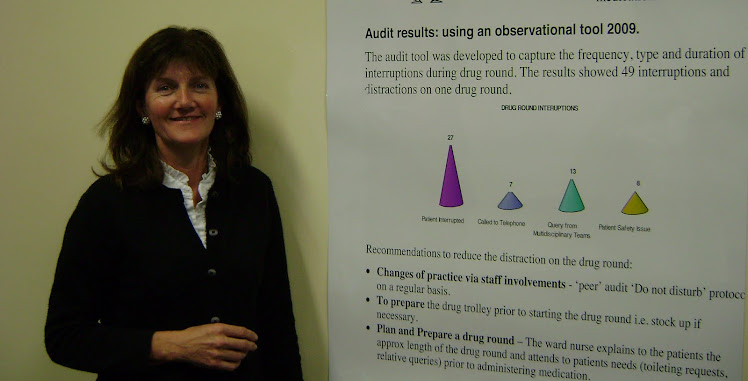
audit conference
Monday, December 10, 2012

Saturday, March 17, 2012
Planning for the 19th April 2012
Happy St. Patrick's Day.

I am planning to organise a study day for the 19th April 2012. I want to show all the hard work that was performed in the 2011 "Setting Standards in Medication Management". The video recordings of each of the specialist presentations are presently being put together as an educational tool. For this study day I want to hold a workshop to demonstrate not only the work from the last years conference but other work that has been done. I am also to putting a workbook that will support nurses while administering medication in the clinical environment.
Any suggestions for this study day would be appreciated.
I need to promote the "first Irish phone App, that was designed by a nurse for a nurse" Dosage Calc for my Irish colleagues. Its bazaar the phone App has reached 106 thousand hits (Android phone) and about 40 thousand for the iphone.
Saturday, February 18, 2012
Still chipping away - trying to find the perfect solution to administering medications safely to patient's.
It is generally assumed that nurses undertaking drug administration have been adequately trained. Competence may be lacking both in the ability to perform requisite numerical calculations (medication calculation, intravenous regulation, and intake and output calculations) and in the ability to conceptualize the mathematical problem. While many nurses are aware of inadequacy in this area, they are unwilling to admit to it. The situation may be exacerbated in specialist areas (e.g., paediatrics) where more complex mathematics is required and where the consequences of miscalculating the dose are far more severe than in adults.
The administration of medication to patients is a significant part of a nurse’s role. Nurses frequently experience many interruptions during medication administration, which may lead to increasing errors. The causes of poor medication management are: Distractions and interruptions, Heavy workload, insufficient educational support and lastly Poor competence in calculations. Working as a Clinical Facilitator with newly qualified as well as experienced staff nurses, I feel that nurses need a lot more support with drug calculations. I consulted a friend of mine who is a computer programmer; we developed an application for mobile phones called “Dosage Calc”.
This application is designed as a ‘second checker’. The idea is that when the nurse is ‘single’ administering medication, she/he can use the application as a means to second check. The idea is that they can use the application to re assure themselves that they have got the correct answer. Among other things, the application covers tablet dosage, volume of liquids and dosage for body weight but also covers IV drop rates for infusions. The beauty of using this application is that it be used when mobile is in ‘flight mode’.
Monday, October 3, 2011
Drug treatment in Urology
The final conference came about so quickly, it was on the 19th September 2011, . The theme of the conference was on drug treatments in Urology. We had an excellent program lined up for the day. As usual I conducted the pre- lecture survey, asking attendees about their knowledge on urology and some of the treatments provided in the area.
The first lecture was given by Brid Byrne from A&E in St. Michael's Hospital. Brid gave us a very comprehensive and detailed talk on the anatomy and the physiology of the urinary tract as you will read below
https://docs.google.com/present/edit?id=0AfiCRfy-aXfjZG45cGg0bl8xOTY5ZHc0YjN4dmg&hl=en_US
The second lecture was given by Mary Jacob, AMP Women's Health. National Maternity Hospital. The title of her presentation was "Nurse prescribing, continence /overactive bladder". In her lecture she described the different types of bladder storage problems: overactive bladder, stress urinary incontinence and mixed incontinence. Mary described the symptoms and the treatments for over active bladder. How the medical management can be divided into either drug agents or behavioural modification. She completed her excellent presentation by describing the side effects of medications for urgency urinary incontinence. I have downloaded it below.
https://docs.google.com/leaf?id=0B_iCRfy-aXfjNzNlYTc1MTYtMGVjMy00ZmVhLTlkYTgtMzQ4NzFhNmY2Mzhj&hl=en_US
The next presentation was from Teresa Ronan Product specialist from Braun Company. Teresa discussed the two types of catheterisation: intermittent Catheterisation (being a clean procedure) and Indwelling catheterisation (being a sterile procedure). In her lecture she then described how the indwelling catheter was subdivided into urethral and supra-pubic catheterisation. She talked about the associated risks with the urethral and the supra-pubic infection - 44% of hospitalised patients develop urinary tract infections. She gave useful guidance on how to manage urinary tract infection and gave advice on catheter blockage and use of maintenance solutions.
https://docs.google.com/leaf?id=0B_iCRfy-aXfjMTExMmEyN2ItMzViYi00MGI2LTk1NWQtOTg5YTM2ZjYwNzM3&hl=en_US
The follow-on lecture after the coffee break was from Helen Forristal, Urology Cancer Nurse Specialist from St. Vincent’s University Hospital. She presented with Intravesical Treatments for Bladder Cancer. She described the stages of bladder cancer: Primary tumour to extended lymph node involvement to presence and the extent of distant metastases. She talked about the alarming report re- the CIS (Carcinoma in situ) where there is a high risk of disease progression, with an average 54% developing invasive disease in a five year period. She then presented on the uses of Mitomycin C answeing questions e.g. When is Mitomycin C used? Why use Mitomycin? The side effect profile, the single dose Mitomycin C, the 4-8 week course Mitomycin C, the maintenance of Mitomycin C and lastly she talked about Patient Information.
Next Helen explained about the comparison of BCG – Bacillus Calmette Guerin with Mitomycin C. How BCG is a live attenuated tuberculosis vaccine and that it has a neoplastic effect on the tumour. How it should be considered for patient’s following a Trans Urethral Resection for the prophylaxis of tumour recurrence in patients with medium to high risk Ta and T1 bladder cancer. How it has been quoted that "BCG is said to be superior to Mitomycin C in reducing recurrence of bladder cancer". Helan then talked about the use of BCG for the patient and the HCP. As well as the health and safety issues associated with BCG.
https://docs.google.com/viewer?a=v&pid=explorer&chrome=true&srcid=0B_iCRfy-aXfjMGZkOWJiMjUtMGM2Yy00YWEwLWI3ZjItNDgxM2JjNDllZTc4&hl=en_US
https://docs.google.com/viewer?a=v&pid=explorer&chrome=true&srcid=0B_iCRfy-aXfjMGZkOWJiMjUtMGM2Yy00YWEwLWI3ZjItNDgxM2JjNDllZTc4&hl=en_US
Helen's second lecture was on hormonal treatment for Prostate Cancer. She talked of how prostate cancer is the most commonly diagnosed cancer amongst men in many industrialised nations. Rates of prostate cancer vary widely across the world. Although the rates vary widely between countries, it is least common in South and East Asia, more common in Europe, and most common in the United States. (American Cancer Society). She talked about the routine investigations from DRE (digital rectal examination), to TRUS guided biopsy to bone (if applicable). How Prostate cancer is hormone-dependent LHRH, luteinising hormone-releasing hormone LH, luteinising hormone ACTH and adrenocorticotrophin. Helen then discussed the Medical Endocrine Therapy Options: LHRH analogue, Anti-androgen and Oestrogen. She gave a breakdown of the main side effects of these treatments. Helen completed her presentation on the importance of the holistic care of the patient.
https://docs.google.com/viewer?a=v&pid=explorer&chrome=true&srcid=0B_iCRfy-aXfjM2FhZWRmZDEtN2M1MS00YjgwLTk4YmQtN2U5OGZmY2IyYTg4&hl=en_US
https://docs.google.com/leaf?id=0B_iCRfy-aXfjOWIwYThkNjYtN2ExOC00ZDY2LWE2N2UtMjBmMDljNjFjZWZj&hl=en_US
https://docs.google.com/viewer?a=v&pid=explorer&chrome=true&srcid=0B_iCRfy-aXfjM2FhZWRmZDEtN2M1MS00YjgwLTk4YmQtN2U5OGZmY2IyYTg4&hl=en_US
Mary spoke about benign prostate hyperplasia (BPH) and that this is a common condition affecting older men. BPH is commonly defined as a benign enlargement of the prostate gland due to an increase in cellular proliferation which can lead to a range of lower urinary tract symptoms (LUTS).
This condition has a very significant impact on the activities of daily living. She spoke about the assessment of these patient’s in the Uroflow Clinic, and follow up in the Urology Outpatient’s Department. The patient will have blood tests for PSA, U&E. Digital rectal examination and residual urine
volume is measured. The medical treatments currently available are, Alpha Blockers, 5 Alpha Reductase Inhibitors, Combination therapy, and drugs for overactive bladder.
If medical therapy fails, surgery may be indicated.
https://docs.google.com/leaf?id=0B_iCRfy-aXfjOWIwYThkNjYtN2ExOC00ZDY2LWE2N2UtMjBmMDljNjFjZWZj&hl=en_US
Tuesday, August 23, 2011
Pain conference on the 19th August 2011.
The second last conference was held last Friday - 19th August. I must say we had an excellent line-up of presentations. To start the day, I discussed the objectives of the six conferences and how education on drugs is a necessity for nurses. Where medicines are prescribed by the doctor and dispensed by the pharmacist, but the responsibility for correct administration rests with the nurse!!
The first lecture of the day started off with Lynn O'Connor MSC, CNS Pain Management from the Beacon Hospital, Dublin. Her lecture was titled; "Medication choices related to assessment". Here Lynn discusses: how to consider the individuality of each patient/person in pain; How important it is to gain the best understanding possible of the intensity and nature of the patient's pain, the awareness of the WHO analgesic ladder. Lastly, to reassess the patient's pain management in order to determine the effectiveness of the analgesia.
The second lecture was given by Maeve Kinsella MSC, H dip Pain Management BSc, CNM 1. Her lecture was on "The Classification of Pain", describing in her lecture - The definitions on; How pain happens; the classifications of pain and the nursing priorities.
The third lecture "Pain Assessment" Jeane Barber CNS Palliative Care RGN, RCN, RM. H. Dip Palliative Care, Dip Gerontology, BSc, and MSC. Her power point presentation will be posted at a later date. Just to add I have included Jeans' presentation today.
The following two lectures were given by Maire Murray Chief pharmacist, St. Michael's Hospital. Regrettably, she chose not to be videoed or have her slides posted on line (as was of course her right).
After lunch we had Dr. Maeve Nolan, D. Clinical Psych, Spinal Injury Team, National Rehabilitation Hospital. Her talk was on ‘The psychological impact of pain and psychological approaches to pain management'. Maeve discussed the Psychological impact of pain; Psychological with all that its complexity and then she discussed the approaches to treatment for chronic pain.
The next lecture I was proud to introduce my sister Elaine. Elaine CNS Acute Pain management, RGN, RCN, BSc and MSC in St. Vincent’s University Dublin 4. She lectured on ‘What is Acute Pain’? The Pain Pathway / Types of Pain. Acute Pain Management: The Multimodal approach: Acute Pain Pump, PCAs, Epidurals, Paravertebral Analgesia, Spinal / Intrathecal Analgesia.
The final lecture of the day was presented by Ann Duffy from the Clinical Risk Advisor, State Claims Agency. Clinical Indemnity Scheme. Ann talked about her role as a Clinical Risk Advisor, The CIS –‘who we are and what we do’, the STARS Web site, Medication incidents and lastly, open disclosure following an adverse event.
The last lecture was cancelled due to lack of time. Here I was going to do a brief version of the 'WHO' ‘Patient safety Workshop’ - learning from error. This is a video that shows a chilling event where after a drug error that has harmed a patient, (has occured), we as healthcare workers we ask, how did this happen? The objective of this workshop was to understand the extent of the problem that faces health-care workers and patients.
The last task of the day is to collect the post survey and the evaluation sheets. I provided a survey questionnaire before and after the conference, this is to find out whether the education we provided on the day, was of value or not. I also provide an evaluation sheet, to get further information about the day. I must say I was toutched by the very positive feedback we got on the day. The attendees were delighted with the level of knowledge of the lectures and the smooth running of the day.
The Pain Agenda for the 19th August
https://docs.google.com/document/d/1Aeh_awoqcTc_0kKQJ5j_ym1vC51NKG0j0yhRfhvQLvw/edit?hl=en_US#
Pain
https://docs.google.com/present/edit?id=0AfiCRfy-aXfjZG45cGg0bl84OTR6dnY4a2ZjcQ&hl=en_US
Clinical Indemnity Scheme.
https://docs.google.com/present/edit?id=0AfiCRfy-aXfjZG45cGg0bl82OTY4NTN3cHBnMg&hl=en_US
Acute Pain
https://docs.google.com/present/edit?id=0AfiCRfy-aXfjZG45cGg0bl81NjhmbXNneGRuNw&hl=en_US
Pain assessment
https://docs.google.com/present/edit?id=0AfiCRfy-aXfjZG45cGg0bl8xMDU1ZzZoNzRoZmg&hl=en_US
The Pain Agenda for the 19th August
https://docs.google.com/document/d/1Aeh_awoqcTc_0kKQJ5j_ym1vC51NKG0j0yhRfhvQLvw/edit?hl=en_US#
Medication choices related to pain assessment presentation.
https://docs.google.com/present/edit?id=0AfiCRfy-aXfjZG45cGg0bl85MDFobmM5dGdjZw&hl=en_USPain
https://docs.google.com/present/edit?id=0AfiCRfy-aXfjZG45cGg0bl84OTR6dnY4a2ZjcQ&hl=en_US
Clinical Indemnity Scheme.
https://docs.google.com/present/edit?id=0AfiCRfy-aXfjZG45cGg0bl82OTY4NTN3cHBnMg&hl=en_US
Acute Pain
https://docs.google.com/present/edit?id=0AfiCRfy-aXfjZG45cGg0bl81NjhmbXNneGRuNw&hl=en_US
Pain assessment
https://docs.google.com/present/edit?id=0AfiCRfy-aXfjZG45cGg0bl8xMDU1ZzZoNzRoZmg&hl=en_US
Wednesday, August 10, 2011
An Bord Altranais eNews for nurses and midwives Issue 2, August 2011
" If you have a query with regard to medication management or your scope of practice you can contact us at ezine@nursingboard.ie or telephone and speak to the Professional Officer for Standards of Practice and Guidance."
My reply:
Dealing with the underlying causes of error requires a concerted effort from every department in the hospital. However to concentrate on one area, a survey by the HSE in 2009 revealed that newly qualified nurses 2007 were concerned about their own skills with drug calculations. This is particularly relevant as single person administration is now very common for economic reasons. Medication administration is perhaps the highest risk activity a nurse can perform, as accidents can lead to devastating consequences for the patient and for the nurse's career.
My reply:
A Quality Initiative to share.
I was reading the section on your website under the subsection “How can we help you” with regards to medication management. I feel there are many factors that can contribute to medication errors including heavy workload, distractions and interruptions. As nurses we have conducted several audits that highlight how nurses are constantly being disturbed or interrupted when administering medications. I feel that as a single administer of medications, I need to be absolutely sure about my calculations of medications I give to my patients. I look at supermarkets and see how the person on the 'check out' while under pressure, can operate efficiently and effectively with the use of bar codes and a cash register. We as nurses do not have the luxury of technology and yet our calculations are far more important than giving back the correct change.
I feel that when we do our drug calculations, we need to have the means to 'second check' - to be absolutely certain that our calculations are correct. In some occasions we are unaware of the errors we create. This is why I feel as a nurse we need to support each other. That's when I did some research about mobile applications on the market. I consulted with a developer friend to produce a simple application for mobile phones called “Dosage Calc”. This can double-check a wide range of common calculations giving the nurse some reassurance. It is worth mentioning that “Dosage Calc” and some other useful apps can be used in “Airplane mode” making interference with equipment very unlikely.
I am proud to say that 'Dosage calc' mobile application, is the first Irish application that is developed by a nurse for the nurse. I sound like a sales person but it is free for nurses (no hidden agenda). The app is currently available as a free download from the Android and iPhone market. I honestly feel that “Dosage Calc.”application can make a difference to the delivery of care. I would welcome any input from those nurses in your readership during the pilot phase.
When researching my thesis on medication management for my MBS in Health and Safety at Work, it became evident that medication errors are an international problem. For example in England, there were 70,036 medication reported errors in one year June 2009-2010 according to the NHS. It is not clear, what percentage of errors remain unreported.
As a Clinical Facilitator that is responsible for the career development of nurses, I read with great interest the article on 28th March in The Irish Times dealing with data compiled by the State Claims Agency over a six year period. This indicated health workers are involved in up to 8,000 medication errors or near-misses per year in Irish hospitals of which over 7,000 are due to incorrect dosage.
As a Clinical Facilitator that is responsible for the career development of nurses, I read with great interest the article on 28th March in The Irish Times dealing with data compiled by the State Claims Agency over a six year period. This indicated health workers are involved in up to 8,000 medication errors or near-misses per year in Irish hospitals of which over 7,000 are due to incorrect dosage.
Dealing with the underlying causes of error requires a concerted effort from every department in the hospital. However to concentrate on one area, a survey by the HSE in 2009 revealed that newly qualified nurses 2007 were concerned about their own skills with drug calculations. This is particularly relevant as single person administration is now very common for economic reasons. Medication administration is perhaps the highest risk activity a nurse can perform, as accidents can lead to devastating consequences for the patient and for the nurse's career.
Unlike some other countries, there is reluctance in Irish hospitals to allow the use of mobile devices among some staff. (I have to say, when it comes to the use of mobile phones there seems to be one rule for nurses and another for the healthcare professions).
Since the release of the application on the Android market alone, got 4338 downloads in the last 3 months. The top four countries that are showing interest are: 1st United States, 2nd Brazil, 3rd Philippines and 4th India. I feel as a nurse we need to progress with technology. After all, if we entrust our nurses to have the responsibility to administer medication we have to have the respect for nurses to use their professional judgement with mobile phones.
Since the release of the application on the Android market alone, got 4338 downloads in the last 3 months. The top four countries that are showing interest are: 1st United States, 2nd Brazil, 3rd Philippines and 4th India. I feel as a nurse we need to progress with technology. After all, if we entrust our nurses to have the responsibility to administer medication we have to have the respect for nurses to use their professional judgement with mobile phones.
Mobile applications are used widely in the USA as “point of care”. Instant access to evidence based information at the bedside. As a practicing practitioner I welcome this aspect of practice. We must also consider that our patients are more informed and knowledgeable about their own conditions. As professional nurses we have to keep up-to-date with the advancements in medicine. I welcome your feedback.
Kind regards
Sunday, July 24, 2011
Drug treatment for Diabetic Disorders
On the 19th July last we held a conference which was focused on nurses working with patient with diabetic disorders. The aim of the conference was to raise awareness of different aspect in diabetes. To share good practice in relation to the support offered by the diabetic nursing team to community and acute healthcare settings.
The conference addressed the following themes:
1. Insulin therapy - covering areas that are frequently asked by nurses I.e. choosing injection regimens/ devices; correct injection techniques; the safe disposable of used sharps; self examination of injection sites and lastly but important, the complications and how to avoid them.
2. Hypoglycaemia - what is involved; the risk factors; classification; signs and symptoms; the treatment of hypo's and again lastly but equally important - prevention of hypoglycaemia.
3. Treatment of type 2 Diabetes Mellitus. How the cornerstone treatment of diabetes mellitus (DM) is diet and exercise. DM is a progressive condition that will progress to the need for oral hypoglycaemic and in time insulin. How with careful exercise and monitoring of diet will delay the progression of the condition.
4. Knowing what to eat is one thing but to be brought by the hand (not literally) through the supermarket is a fantastic idea. The do's and don't of shopping gave us very practical advice.
5. The importance of foot care opened our eyes into the world of podiatry. A service that is relatively new but with such a demand from patients there is plans a foot for further development the service.
6. I invited Ann Duffy from the Clinical Indemity organisation to talk about the state claims agency. Ms. Duffy talked about the reporting system, "The STARS (data base) web site". The types of medication incidents that have been reported and more about the need for open disclosure following adverse events.
The mode of presentation was mostly by PowerPoints and a discussion group. You are invited to download the following presentations.
https://docs.google.com/leaf?id=18-ivZSJ5lQZdhD-PI4gbetjGs4TUZHtaD-pmBQeOleF3GOm2xyW2k0tG_vU9&hl=en_US
The agenda for the 19th July 2011.
https://docs.google.com/document/d/1cXA_cdp9J4Z2mP5rcDpqCCkuvOKxXHZy2jkc_JBHYJA/edit?hl=en_US#
0AfiCRfy-aXfjZG45cGg0bl81MDhkc3I4c2poYw&hl=en_US
https://docs.google.com/present/edit?id=0AfiCRfy-aXfjZG45cGg0bl8zODJoY2I0cnRjMw&hl=en_US
https://docs.google.com/present/edit?id=0AfiCRfy-aXfjZG45cGg0bl8yMDJkenhwYzZmYg&hl=en_US
https://docs.google.com/present/edit?id=0AfiCRfy-aXfjZG45cGg0bl8xMjhjd3JycHMzcg&hl=en_US
The feedback from the conference was very positive. A big thank you for all that made the day possible.
Subscribe to:
Posts (Atom)